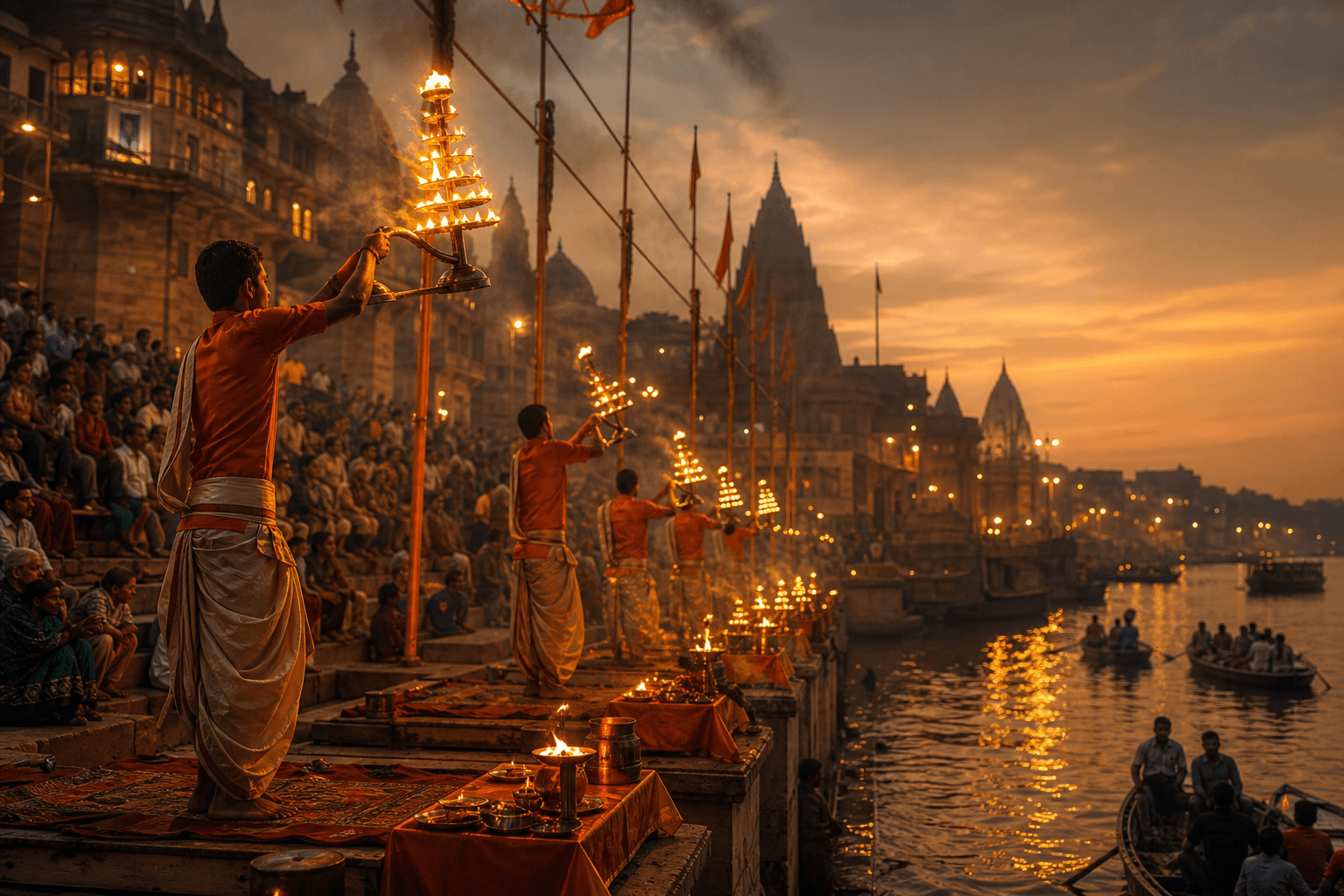
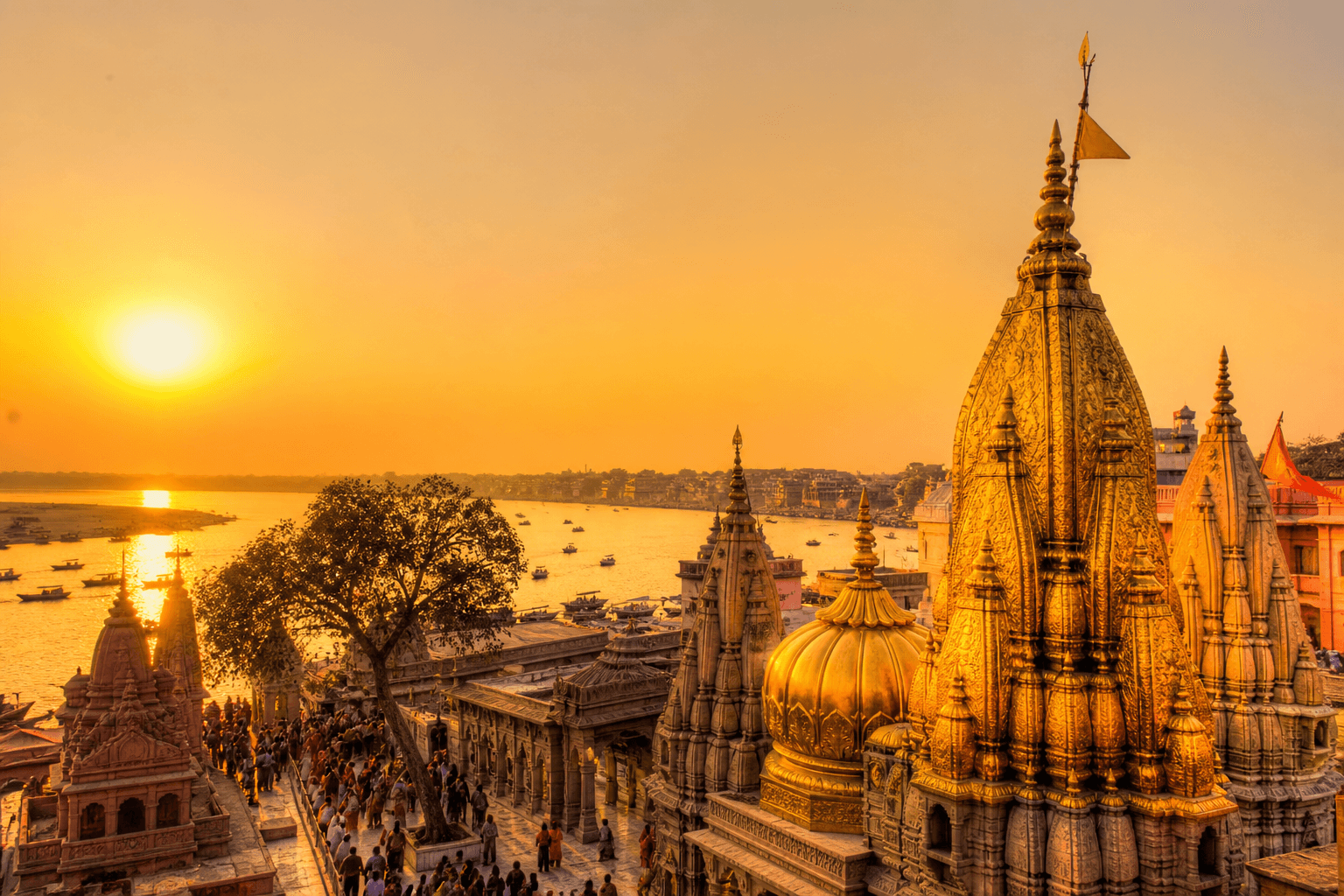
The golden Jyotirlinga at the heart of Kashi — one of twelve holiest Shiva shrines in India.
The shrine that names the city
Kashi — another name for Varanasi — and Vishwanath — Lord of the Universe — meet in this temple complex at the centre of the old city. The Jyotirlinga enshrined here is one of twelve across India, and for many pilgrims it is the reason the journey to Banaras exists at all. Gold-plated domes catch the morning light above lanes so narrow that two people cannot always pass shoulder to shoulder.
Our first series episode walks from Dashashwamedh Ghat toward this shrine at dusk. The corridor has changed the approach, but the density of devotion has not.
Layers of stone and patronage
The present structure owes much to Ahilyabai Holkar, who sponsored a major rebuilding in 1780 after earlier temples were destroyed and rebuilt across centuries. The spire, golden dome, and silver altar around the lingam create a vertical composition that draws the eye upward even in the crush of a busy darshan line. Smaller shrines along Vishwanatha Gali honour Kaal Bhairav, Dhandapani, and other deities — many pilgrims visit these before entering the main sanctum.
The corridor from river to sanctum
The Kashi Vishwanath Dham corridor opened a more direct route from the ghats to the temple, with facilities for elderly pilgrims and a gallery commemorating Ahilyabai Holkar's role in the temple's modern form. Security is strict: expect metal detectors, bag checks, and no photography inside the garbhagriha. The trade-off is access — what once required threading through a maze of shops now has a clearer path, though the lanes themselves remain worth exploring for food, flowers, and brassware.
Saints who walked these lanes
Adi Shankaracharya, Goswami Tulsidas, Guru Nanak, and Swami Vivekananda are among those recorded as having prayed here. The temple is not only architecture but argument — about who may enter, how Shiva should be worshipped, and what it means for a city to centre itself on a single stone lingam. You feel that argument in the queue, in the bells, in the priests who chant without pause.
Pair your pilgrimage
Combine darshan with the evening aarti at Dashashwamedh, a morning at Manikarnika to understand Kashi's relationship with mortality, or a visit to Sankat Mochan across the river for Hanuman devotees. The spiritual circuit package includes both the ghat and this temple on its first day.
Visitor tips
- Mobile phones and bags are not allowed inside the main sanctum — use the free cloakroom near the corridor entrance
- Expect queues during Shivaratri and Kartik month; early morning darshan is often shorter
- Dress conservatively; shoulders and knees covered
From the series
Films and upcoming schedules
Episode 1
Dusk at Dashashwamedh
Episode one opens on the ghats at golden hour — lamps, aarti and the eternal rhythm of Kashi.
Watch the episode →Episode 4 · Coming soon
Flames at Manikarnika
A planned docuseries episode tracing the ghat where cremation fires have burned without interruption for centuries.
Follow production →Docuseries Schedule 5
Dashashwamedh → Manikarnika
Planned — part of The Ghats of Varanasi, our 11-schedule cinema docuseries across 84 contiguous ghats.
View the docuseries pitch →Field notes
Stories from this stop
Kaal Bhairav — the keeper of Kashi
At the city's fierce edge, Bhairav watches who enters and who leaves — the temple most pilgrims miss and none should ignore.
Read the story →Silk thread — the Banarasi loom at work
In a Madanpura lane, the shuttle moves and a sari begins — Varanasi weaving as living heritage, not souvenir.
Read the story →Packages
Tours that include this stop
4 days · Showcase
Banarasi culture
Weaving houses, classical music evenings and old-city food walks.
View package →7 days · Showcase
Spiritual package
Ghat sunrise, temple darshan and guided ritual across the circuit.
View package →Visitor questions
The temple generally opens around 2:30 AM for Mangala Aarti and closes near 11:00 PM. Timings shift on festival days — check locally the day before you visit.